Build a life
worth remembering.
Most people are not short on ideas about how to live better. They are short on follow-through. Lived is a concept for a mobile product built for that gap.
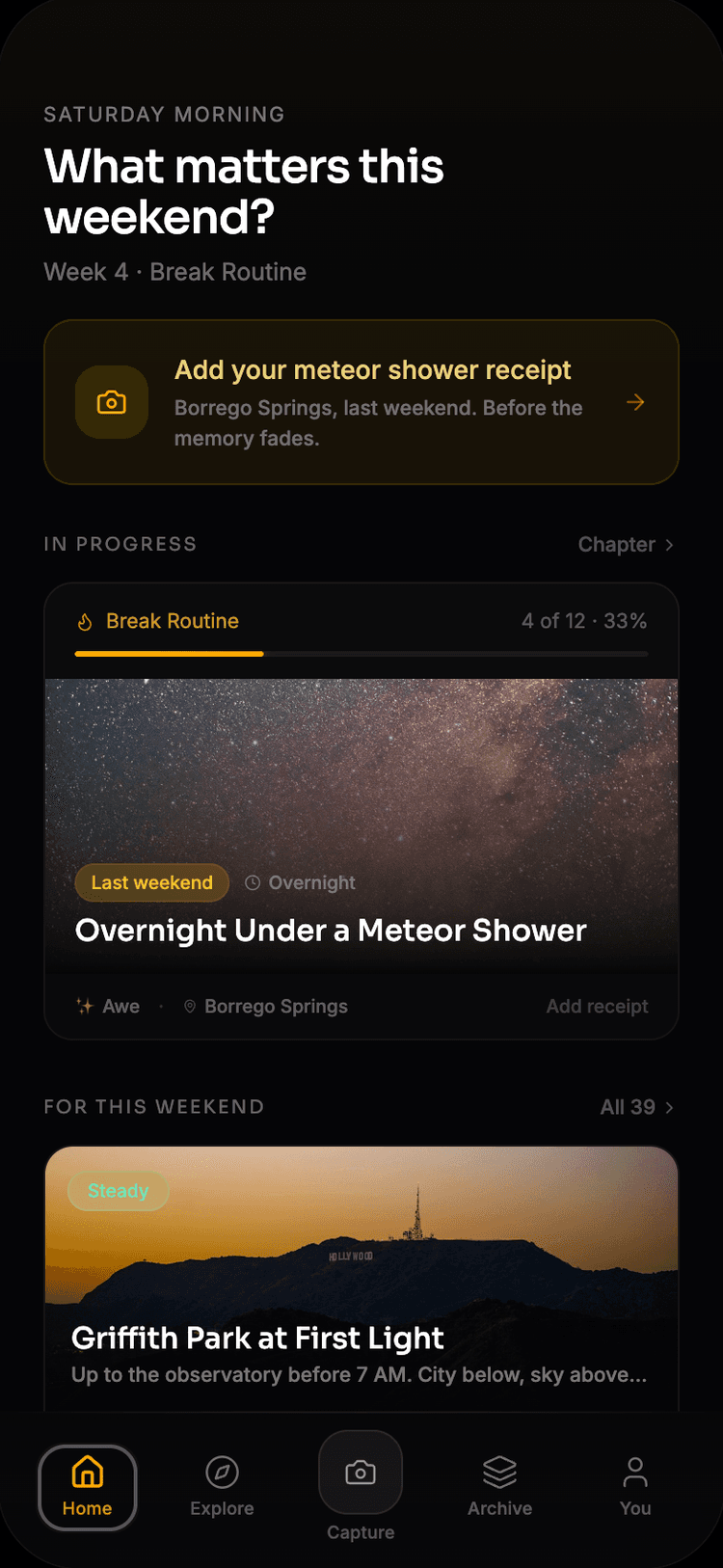
Most people do not need more content. They need more real life.
Most people already have a shortlist in their head. A place they have been meaning to visit. Something they always wanted to try. A weekend they keep putting off. The ideas are usually not the problem.
The hard part is what happens next.
Routine wins. Convenience wins. The easiest option wins. Not because people do not care about their time, but because follow-through usually has more friction than staying home.
It often affects the people who already care a lot about how they spend their time.
Lived is designed for that gap between the life someone imagines and the life they actually live.
The gap between intention and follow-through is not a motivation problem. It is a design problem.
Not a bucket list. Not another recommendations app.
Lived is a tool for people who keep meaning to do things and keep not doing them.
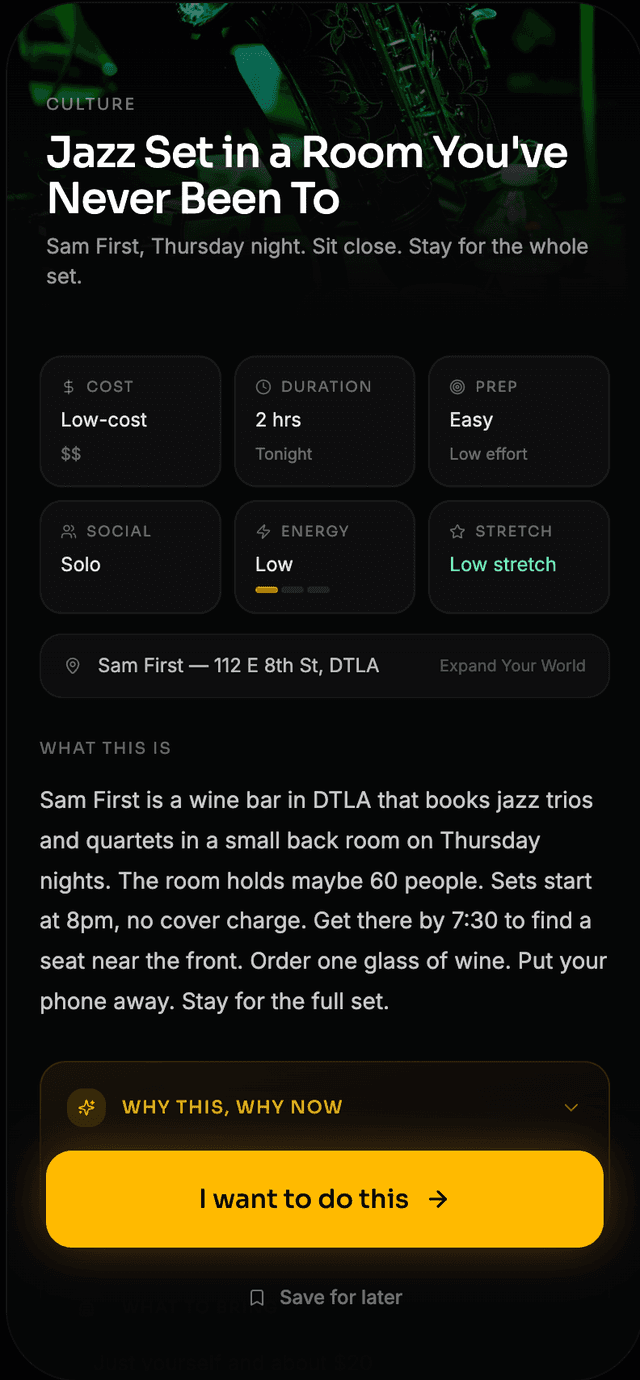
It surfaces experiences that actually fit: the right energy level, the right budget, the right amount of novelty for where someone is right now. Then it helps with everything that usually stops follow-through: planning, timing, and the first step that gets it moving.
It is part recommendation engine, part planning layer, part private archive.
The point is not just to find things to do. The point is to actually live them.
Experience creates a different kind of value.
A good life is not built only through goals, routines, and optimization. It is also shaped by experience.
Trying new things expands comfort zones. It builds confidence. It helps people discover taste, interests, and identity. It creates memories that last and moments that can open unexpected doors.
Experiences tend to create stronger long-term value than possessions. Novelty matters. Reflection often adds more value than people expect. And over time, people often regret what they did not do more than what they did.
Lived is built on that idea.
Not every moment has to be dramatic. A more intentional life is often built through doing, noticing, and following through more often.
97%
Alive score
The highest-rated experiences in prototype testing were novel, outdoors, and taken alone despite low initial motivation.
86%
Average across nine experiences
Users who reflected on experiences afterward rated them higher than they expected going in.
Five steps from intention to experience
Start with what matters to you
Lived begins by learning what makes you feel most alive, what kind of experiences you want more of, and what kind of chapter you are in right now.
Get recommendations that actually fit
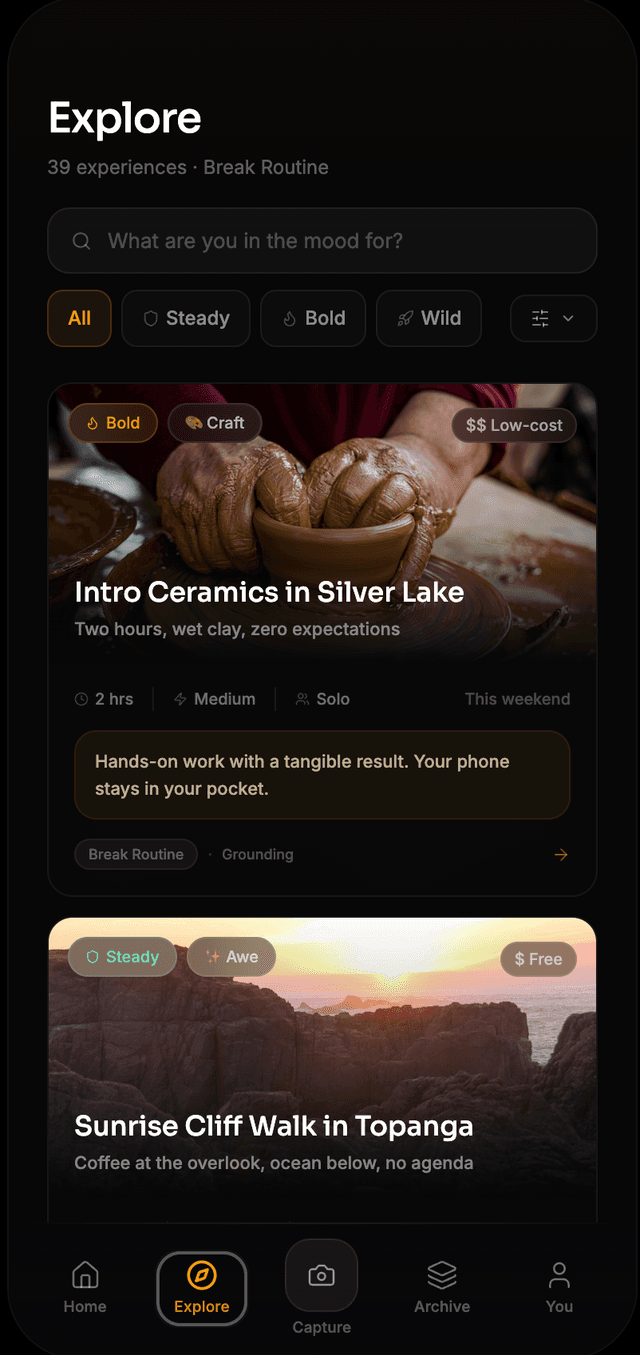
Instead of broad listings, Lived surfaces experiences based on your energy, budget, time, comfort zone, and direction.
Make it real
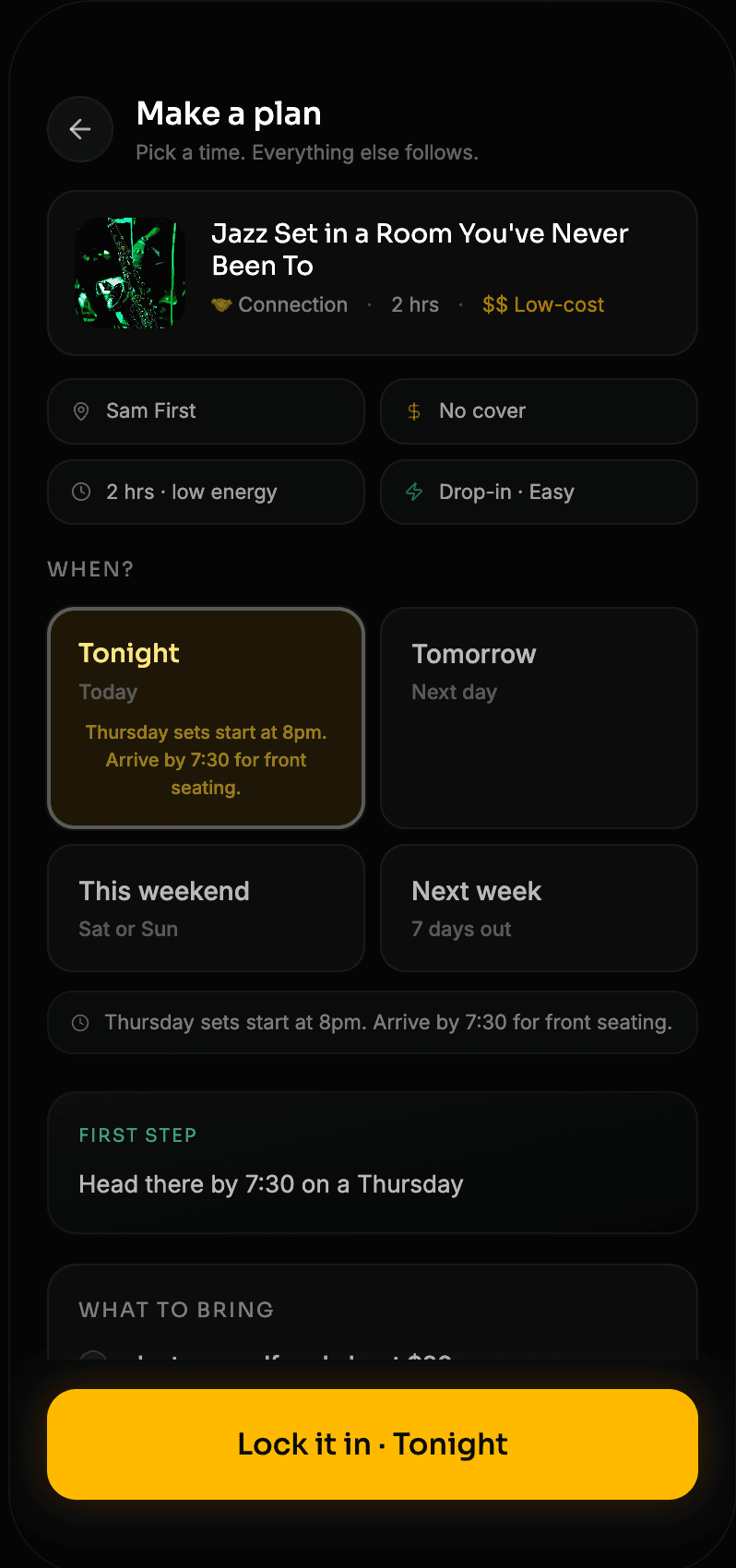
Once something feels right, Lived helps with the things that usually stop it from happening: timing, logistics, and a concrete first step.
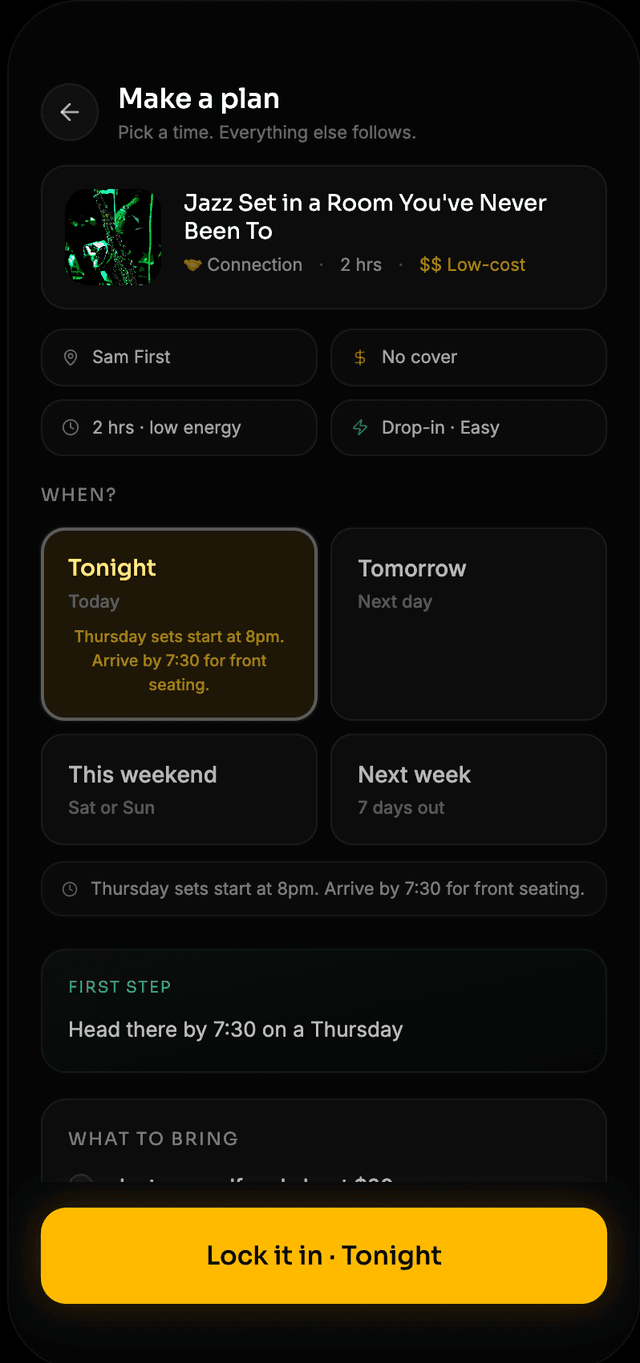
Capture the moment
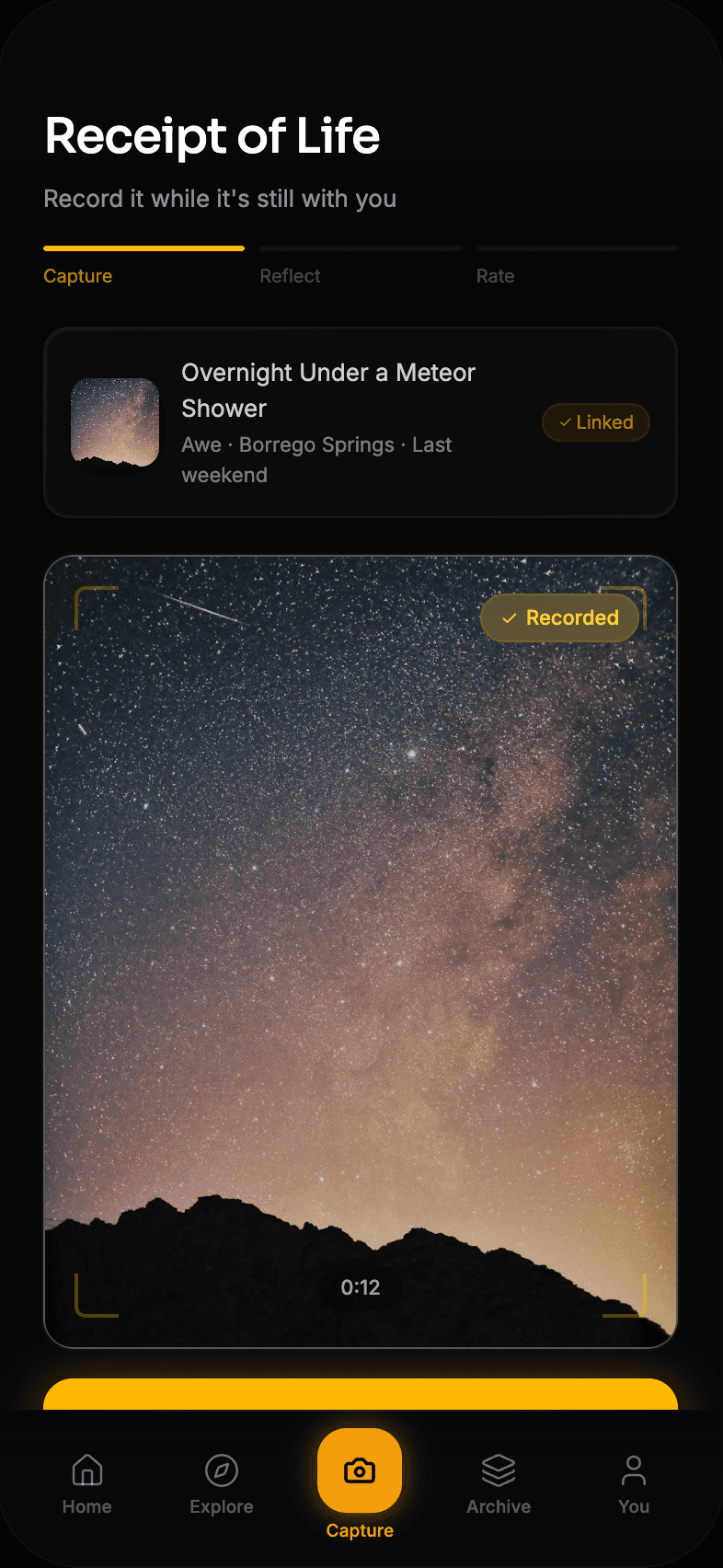
Afterward, a short capture ritual: a photo, a reflection, a rating. Private and quick enough to do while the experience is still with you.
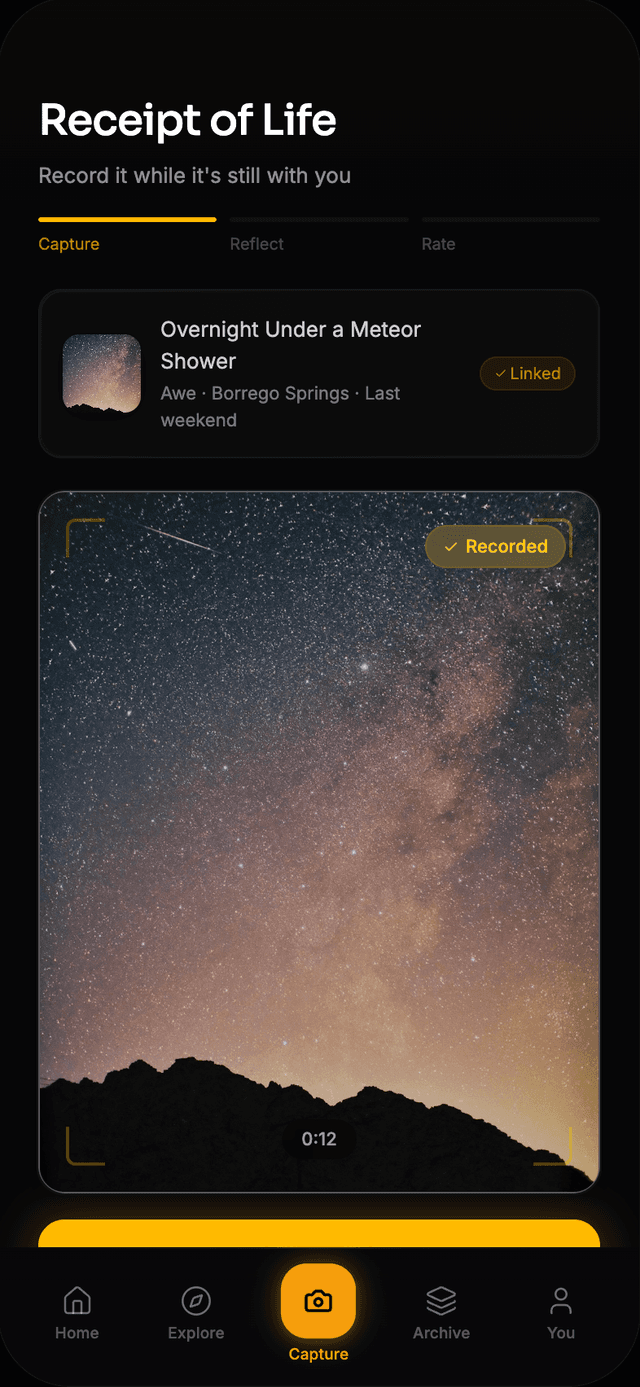
Build momentum over time
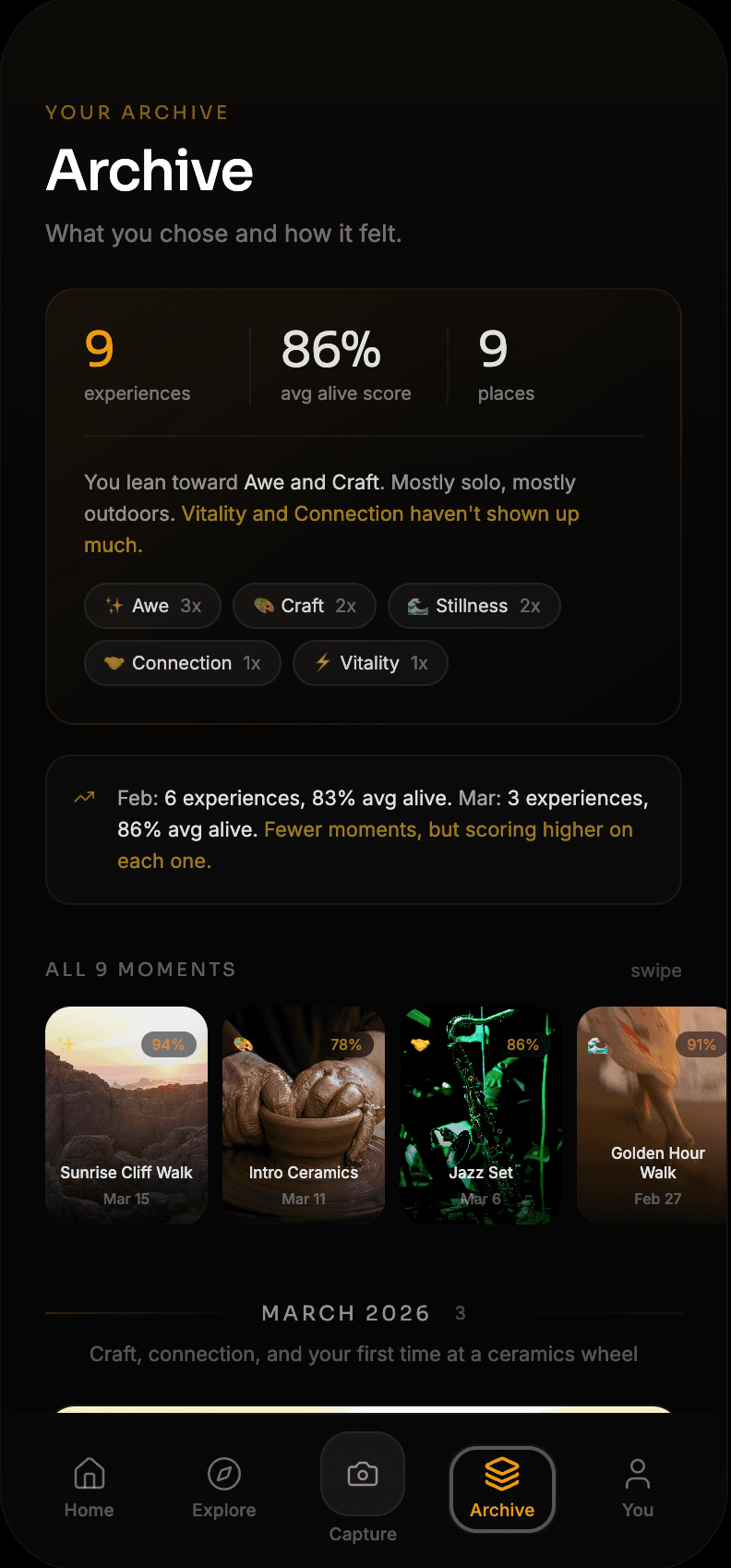
Those moments become part of a growing archive and recap system that helps users see how their life is taking shape.
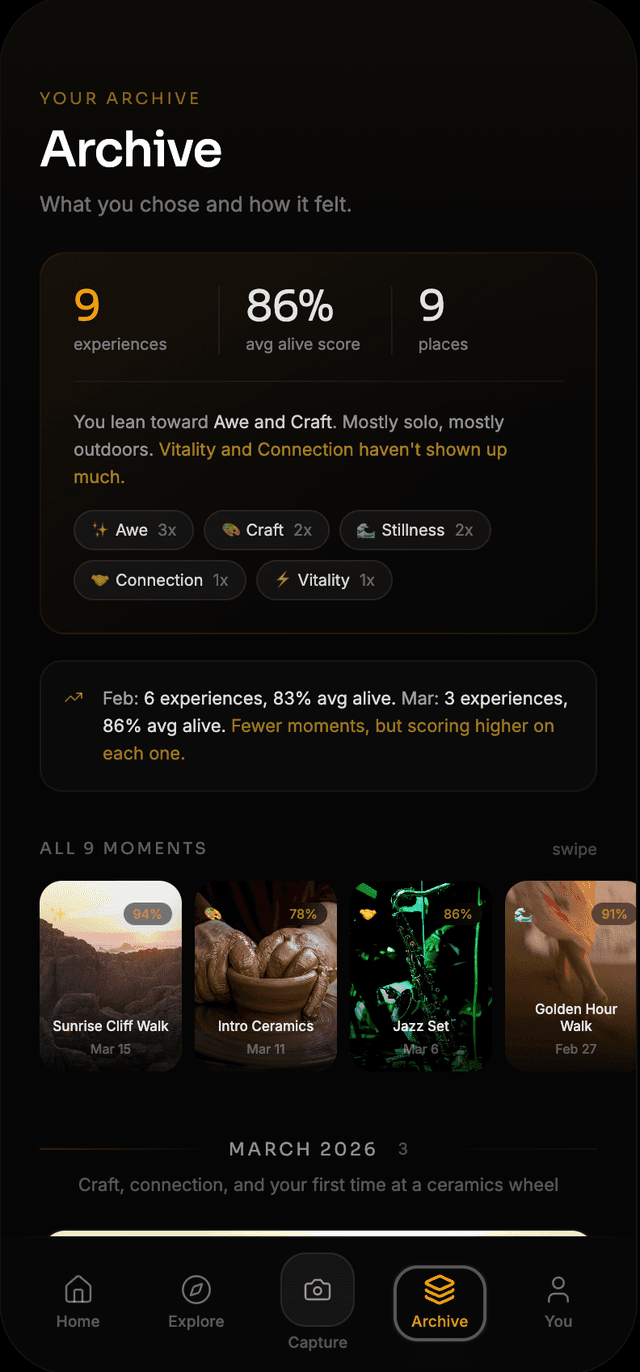
Inside the product
Curated experiences filtered by energy, time, cost, and how far outside your comfort zone you want to go.
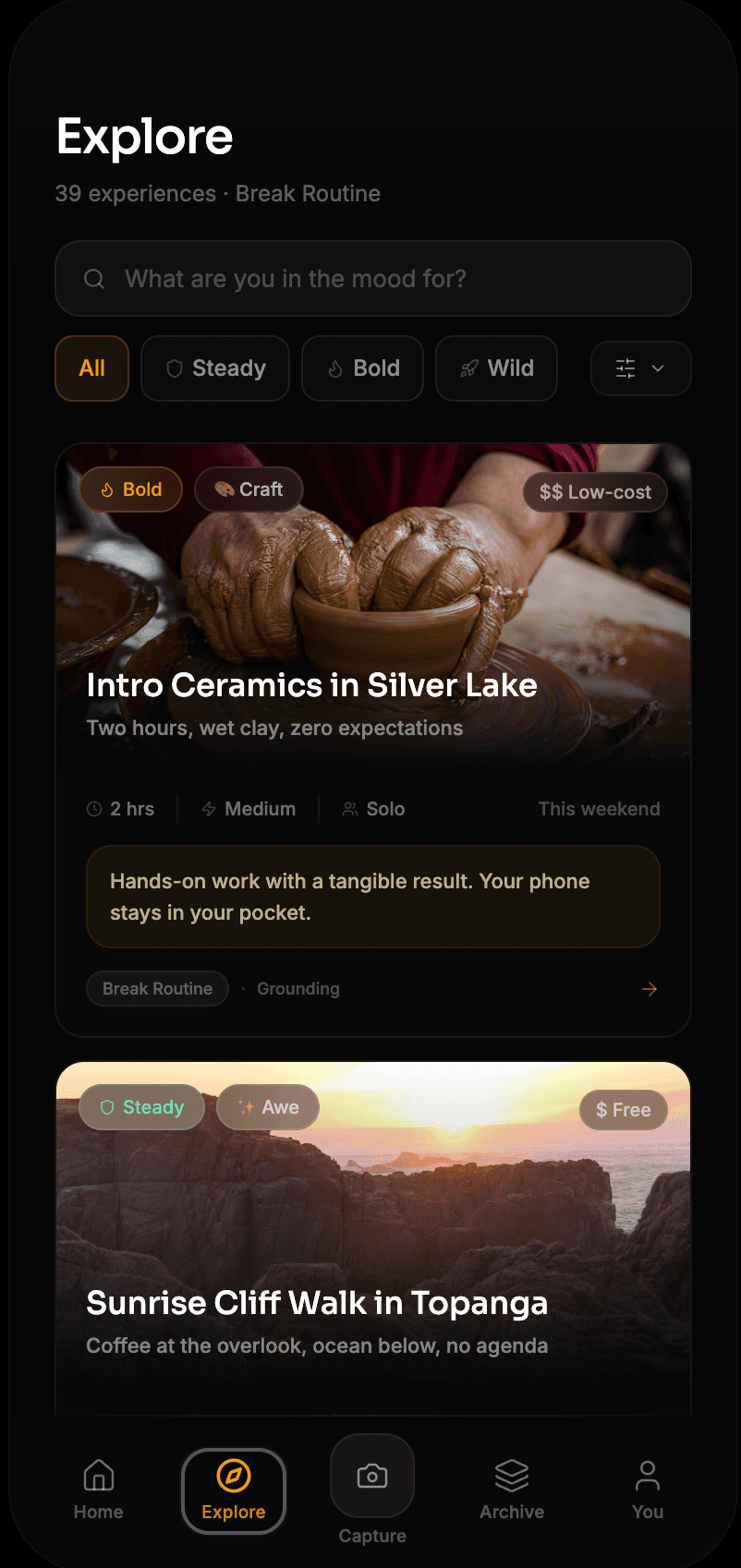
Practical details, a first step, and a time to lock it in.
A short capture ritual. Photo, reflection, rating. Private and yours while the experience is still with you.
Every experience you have logged, what it meant, and how your taste and range are evolving over time.
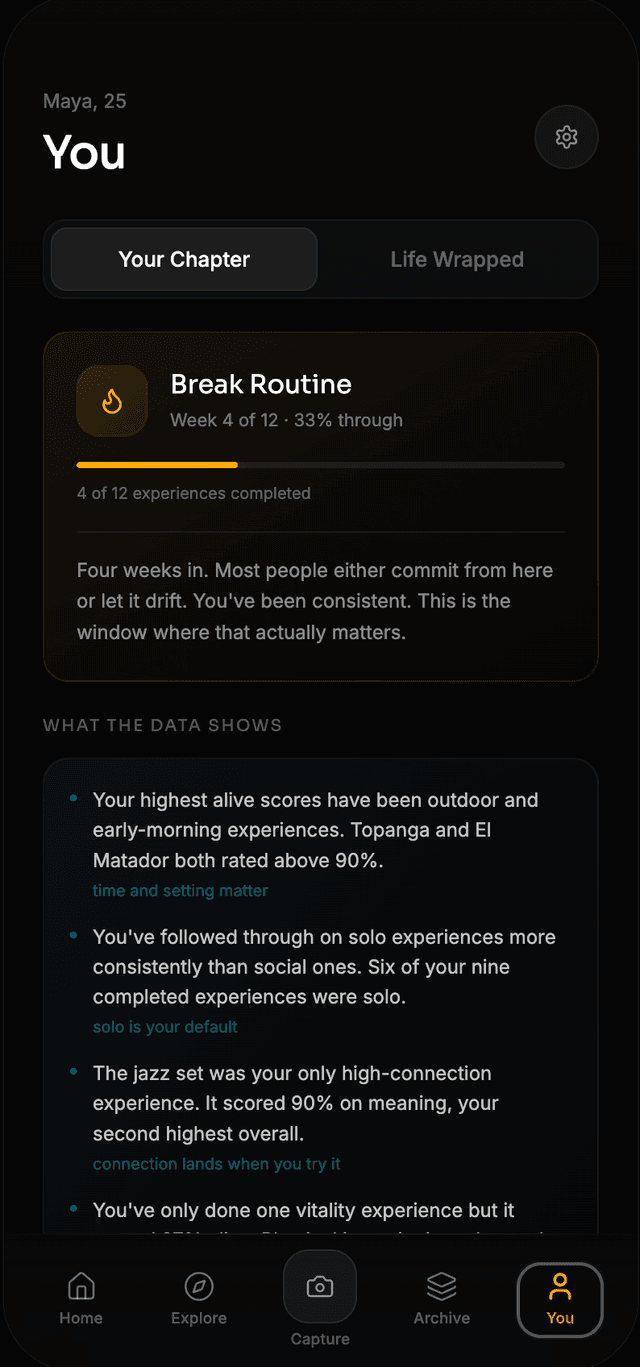
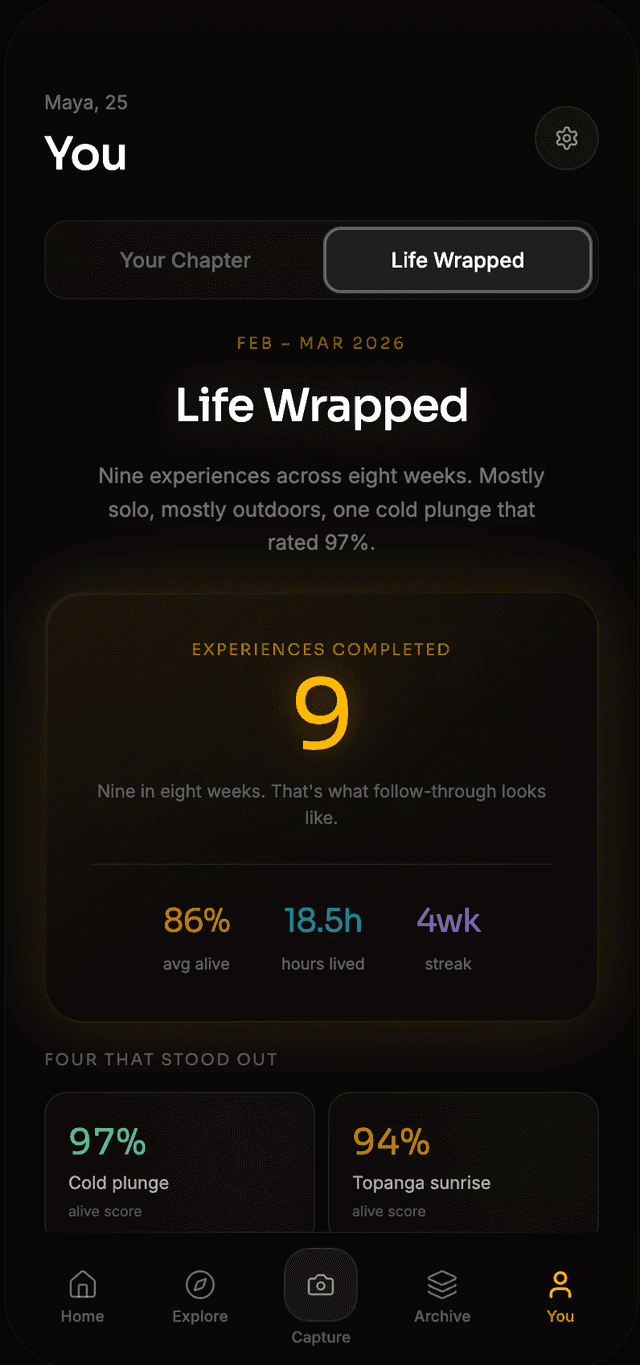
A recap of how your life is taking shape.
At the end of every chapter, Lived surfaces the patterns, the highlights, and the experiences you actually followed through on. Not a summary of content consumed. A summary of a life lived.
9
experiences
86%
avg alive score
4wk
streak
What makes Lived different
Adjacent tools solve one part
Most adjacent products solve one part of the problem.
Some help people discover things to do. Some help them plan. Some help them journal. Some help them track habits, moods, or goals.
Lived connects the whole loop.
Desire, discovery, planning, follow-through, reflection, and memory, all in one place. It is not built for content consumption or self-optimization. It is built to help people close the gap between the experiences they intend to have and the ones they actually do.
It is not trying to optimize a person. It is trying to help them live more intentionally.
Built on research
Lived is grounded in multiple rounds of research across behavioral science, competitive analysis, digital signal scanning, and prototype testing.
Research methods
Patterns that came up consistently
Experiences often create stronger long-term value than possessions
Planning can be part of the reward, not just friction
Novelty and psychologically rich experiences matter
Beyond inspiration, users want practical help making things actually happen
Reflection and memory add long-term value
Generic recommendations weaken trust fast
Low-value defaults are the real problem, not rest itself
Lived evolved directly from those findings.
If Lived were built for real
Lived works best when it is built around what users get out of their time, not what the product gets out of their attention.
The goal would not be to maximize time in the app. It would be to help people use their actual time better. More follow-through. More moments that really happened. Less defaulting to whatever required the least effort.
That means no advertising model. No engagement-first incentives. A revenue structure where the product earns by being genuinely useful, not by competing for attention.
In practice, that could look like a nonprofit structure, or a model where revenue covers operating costs and improves the system while the product stays accessible regardless of how much someone spends on experiences.
Possible next steps
Deepen recommendation quality and personalization
Expand the experience library
Improve logistical support and real-world integrations
Make archive and reflection tools richer over time
Test how the product supports different user types and life stages
Walk through the full concept
See how Lived moves someone from wanting an experience to actually having it, and what it looks like to build from there.